
Hemorrhoids, commonly called piles, affect millions of people across India every year. While many think all hemorrhoids are the same, the truth is internal and external piles require different approaches to treatment and management.
This guide walks through the anatomy, symptoms, grading, causes, diagnosis, and treatment of both types, so you know exactly what you're dealing with and when it's time to stop self-treating and see a general surgeon.
What Are Hemorrhoids and Why They Happen
Hemorrhoids are swollen blood vessels in and around the rectum and anus. They're not a disease, they're a natural response to pressure, strain, or inflammation in the lower digestive tract.
Many people develop hemorrhoids due to chronic constipation, prolonged sitting, heavy lifting, or during pregnancy when extra weight puts pressure on the rectal veins. Dietary habits, especially a low-fiber diet common in urban Indian households, significantly increase the risk.
Dehydration and irregular bathroom habits also play a role. The good news is that hemorrhoids are incredibly common and highly treatable. Understanding whether you have internal or external hemorrhoids is the first step toward effective management.
Most people experience hemorrhoids at some point in their lives, and they're rarely dangerous if properly managed. However, ignoring persistent symptoms or delaying care can lead to complications like blood clots or severe bleeding.
Key Differences Between Internal and External Hemorrhoids
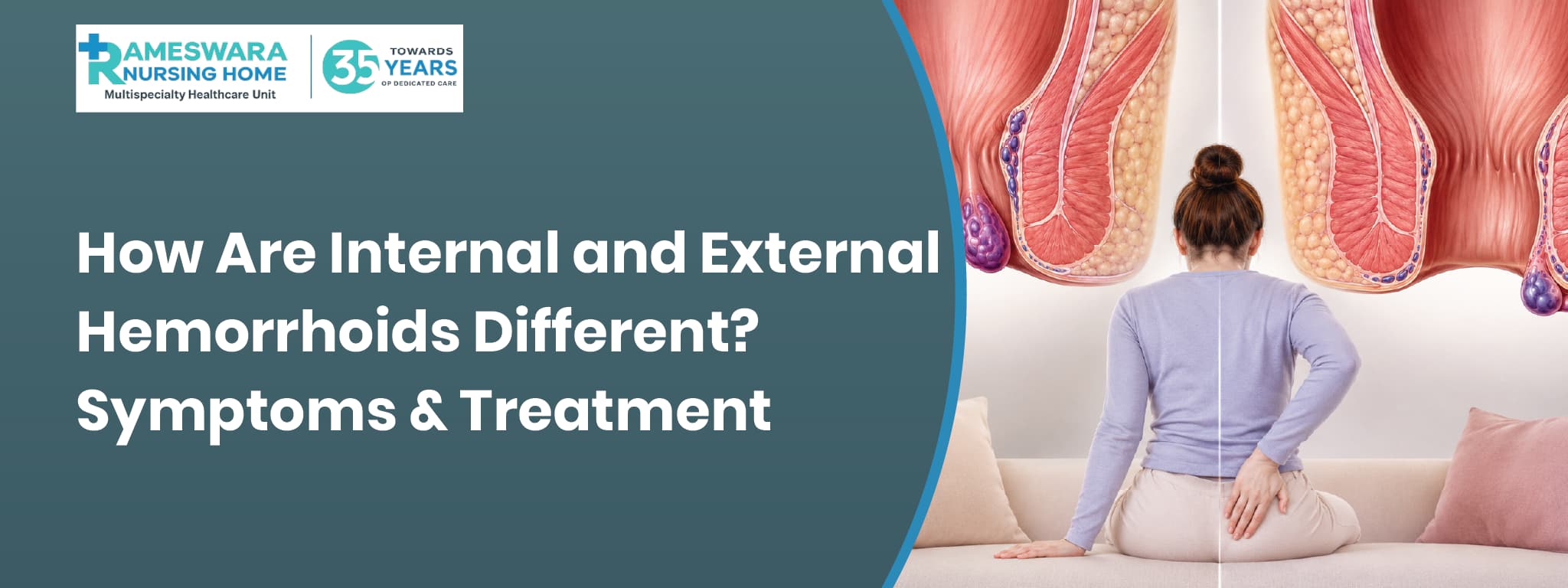
The primary difference lies in location. Internal hemorrhoids develop above the dentate line, which is a natural boundary inside the anus, and are covered by mucous membrane tissue.
External hemorrhoids form below this line, under the skin around the anus, where pain-sensitive nerve endings are concentrated. This anatomical difference explains why external hemorrhoids hurt more, the skin covering them contains many pain receptors, while internal hemorrhoids have fewer pain fibers.
Internal hemorrhoids are more prone to bleeding because the tissue is more delicate and easily irritated. External hemorrhoids are more likely to cause itching and discomfort, especially when sitting or during bowel movements.
| Feature | Internal Hemorrhoids | External Hemorrhoids |
|---|---|---|
| Location | Above the anus | Below the anus |
| Pain sensation | Usually painless | Often painful |
| Bleeding | More common | Less common |
| Visible bulges | Usually internal | Often visible |
| Itching | Less typical | Very common |
| Treatment complexity | Varies widely | Often simpler |
What Causes Both Types of Hemorrhoids?
Internal and external hemorrhoids share the same underlying triggers, sustained pressure on the veins of the anal canal. The most common contributing factors seen in Indian patients include:
-
Chronic constipation or straining during bowel movements
-
Prolonged sitting on the toilet, including scrolling on a phone during a bowel movement
-
Low-fibre diets and inadequate water intake, common with rice- and refined-carbohydrate-heavy meals
-
Pregnancy and vaginal childbirth, due to increased pelvic pressure
-
Obesity and a sedentary desk-job lifestyle
-
Heavy lifting and chronic coughing, which raise intra-abdominal pressure
-
Ageing, which weakens the connective tissue supporting the anal cushions
-
A family history of hemorrhoidal disease
How Doctors Actually Diagnose Internal vs External Hemorrhoids
A proper diagnosis is never guesswork, and it never relies on symptoms alone, because rectal bleeding can also come from fissures, polyps, or colorectal cancer.
Here is what a genuine general-surgery evaluation for suspected hemorrhoids typically looks like, based on the standard outpatient pathway followed at Rameswaram nursing home general surgery department:
-
Step 1 — History: the surgeon asks about bleeding pattern, pain, bowel habits, diet, family history, and any weight loss or anemia symptoms.
-
Step 2 — Visual inspection: the anal skin is examined first, which is usually enough to confirm or rule out external hemorrhoids.
-
Step 3 — Digital rectal exam (DRE): a gloved, lubricated finger check to feel for internal masses, tenderness, or a prolapsed hemorrhoid.
-
Step 4 — Proctoscopy/anoscopy: a short, well-tolerated in-clinic procedure using a lit scope to directly visualise internal hemorrhoids and grade them accurately.
-
Step 5 — Further work-up if needed: patients above 45, those with a family history of colorectal cancer, or those with dark/altered blood in stool are typically advised a colonoscopy to rule out other causes before hemorrhoids are confirmed as the sole diagnosis.
This is precisely why a same-day "it's probably piles" diagnosis without any examination should be treated with caution, the exam itself is quick, but skipping it is how serious conditions get missed.
Treatment Options Compared: Internal vs External
The table below compares each treatment option, including who it is best suited for and what the procedure involves.
| Treatment | Best Suited For | What It Involves |
|---|---|---|
| Fibre, fluids, sitz baths, topical creams | Grade I–II internal; mild external | First-line for almost everyone; relieves symptoms and prevents progression |
| Rubber band ligation | Grade I–III internal | A tight band cuts off blood supply; the hemorrhoid shrinks and falls off within days |
| Sclerotherapy / infrared coagulation | Grade I–II internal (smaller hemorrhoids) | A solution or infrared heat shrinks the hemorrhoid tissue |
| Stapled hemorrhoidopexy / THD (Doppler-guided artery ligation) | Grade III internal, some Grade IV | Minimally invasive; repositions or de-vascularises the hemorrhoidal tissue with less post-op pain than open surgery |
| Hemorrhoidectomy (surgical excision) | Grade IV internal, large/recurrent external, failed banding | Surgical removal under anaesthesia; most effective for advanced disease, longer recovery |
| Thrombectomy (clot removal) | Thrombosed external hemorrhoid, ideally within 72 hours of onset | A small incision drains the clot and gives rapid pain relief |
Notice that internal and external hemorrhoids overlap on lifestyle care but diverge sharply once a procedure is needed, banding, sclerotherapy, THD, and stapling are internal-hemorrhoid procedures, while a painful external lump is usually managed with either conservative care or a quick thrombectomy, not banding.


Hemorrhoid Treatment Cost in Kolkata
Costs vary by hospital, anaesthesia type, and the grade of disease. Based on published Kolkata pricing data, indicative ranges are:
| Procedure | Approximate Cost in Kolkata |
|---|---|
| Outpatient/conservative management | ₹15,000 – ₹20,000 |
| Rubber band ligation | ₹5,000 – ₹20,000 |
| Sclerotherapy (per session) | ≈ ₹5,000 per session |
| Stapled hemorrhoidopexy / THD | ₹38,000 – ₹85,000 |
| Open hemorrhoidectomy (surgical) | ₹25,000 – ₹40,000 (up to ₹60,000 for complex cases) |
These figures are general market indicators, not a quote from any specific hospital, always ask for a written estimate after your consultation and diagnosis, since the final cost depends on the grade, technique, and whether insurance/TPA cashless approval applies.
When to See a Doctor Immediately: Red-Flag Symptoms
Most hemorrhoids are not dangerous, but certain signs mean you should not wait for an OTC cream to work:
-
Heavy or persistent bleeding, or bleeding that leaves you feeling dizzy or unusually tired
-
Blood that is dark or mixed into the stool rather than sitting on its surface
-
Unexplained weight loss alongside rectal bleeding
-
A change in bowel habits lasting more than a few weeks
-
Severe, unrelenting pain with a hard lump, possible thrombosis needing prompt treatment
-
Age 45+ with new rectal bleeding, or any family history of colorectal cancer or inflammatory bowel disease
Common Mistakes People Make With Hemorrhoids
-
Self-labelling every episode of bleeding as "piles" without ever getting an exam
-
Using steroid-containing creams for weeks on end, which can thin and irritate the anal skin
-
Ignoring a sudden, hard, painful lump for more than 72 hours, missing the window when a simple thrombectomy gives the fastest relief
-
Straining harder or spending longer on the toilet (including phone use) to "finish the job", which worsens the underlying pressure
-
Delaying a colonoscopy when advised, simply because symptoms improved temporarily
Also Read: Why Doctors Recommend Colonoscopy Screening From Age 45
Inside Rameswara Nursing Home General Surgery Department
Rameswara Nursing Home, located at P-155 C.I.T. Scheme-VII M, Ultadanga, near P.C. Chandra (HUDCO More), Kolkata, is a NABH-accredited, 50-bed multispecialty hospital with more than 80 specialist consultants across departments.
The General Surgery department includes more than 10 senior consultants and manages hemorrhoids as one of its routine anorectal conditions, offering both non-surgical procedures and open or minimally invasive surgical techniques depending on the grade. The hospital's supporting infrastructure for anorectal and colorectal care includes:
- An 8-bedded ICU for post-operative monitoring after surgical procedures
- In-house proctoscopy, endoscopy, colonoscopy, ultrasound, and pathology, so bleeding can be fully investigated in one facility instead of referring patients elsewhere
- A structured 5-step care pathway: consultation, clinical assessment, diagnostics, treatment, and scheduled follow-up
- Monday–Saturday OPD access and cashless insurance/TPA empanelment
Conclusion
Internal and external hemorrhoids share a cause but not a character, one hides quietly above the dentate line and bleeds without warning, the other announces itself with pain and a lump you can feel.
Knowing which one you're dealing with, and which Goligher grade it has reached, is what actually decides whether fibre and a sitz bath will be enough or whether a same-week procedure is the smarter move.
With hemorrhoidal disease affecting roughly a quarter of Indian adults, there's no reason to treat the conversation as embarrassing or the bleeding as something to just wait out.
A short, painless examination is usually all it takes to get a clear diagnosis and a treatment plan that matches your exact grade and type, and getting that done early is almost always simpler, cheaper, and less painful than waiting for the condition to advance.
Chat with our care assistant on the Rameswaram Nursing home website to get your questions answered, or to book a consultation with our General Surgery department for an in-person examination and a treatment plan suited to your case.
Medical Disclaimer: This article is intended for general informational purposes only and does not constitute medical advice, diagnosis, or treatment. Hemorrhoid symptoms can overlap with other anorectal and colorectal conditions, and only a qualified medical professional can accurately diagnose and grade your condition after a physical examination. Please consult a general surgeon or colorectal specialist, such as those at Rameswaram nursing home for personalised evaluation and treatment.